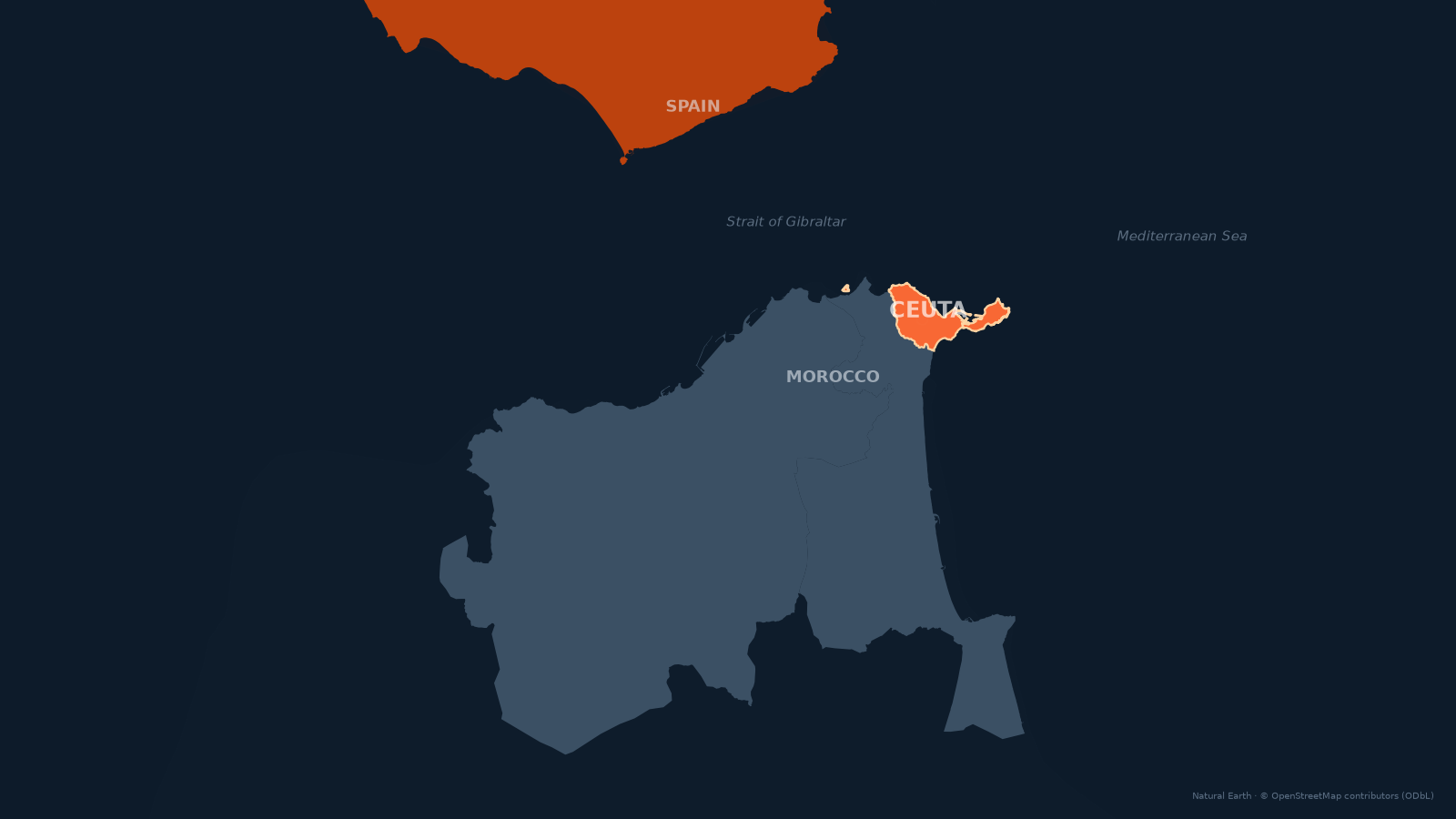
Around 50,000 people crossed into the Spanish enclave of Ceuta from Morocco starting on July 30, 2026, according to data from the Spanish Ministry of the Interior. Of these, approximately 48,000 returned, and 57 bodies were recovered on the Spanish side.
Viral Misinformation and AI Forgeries
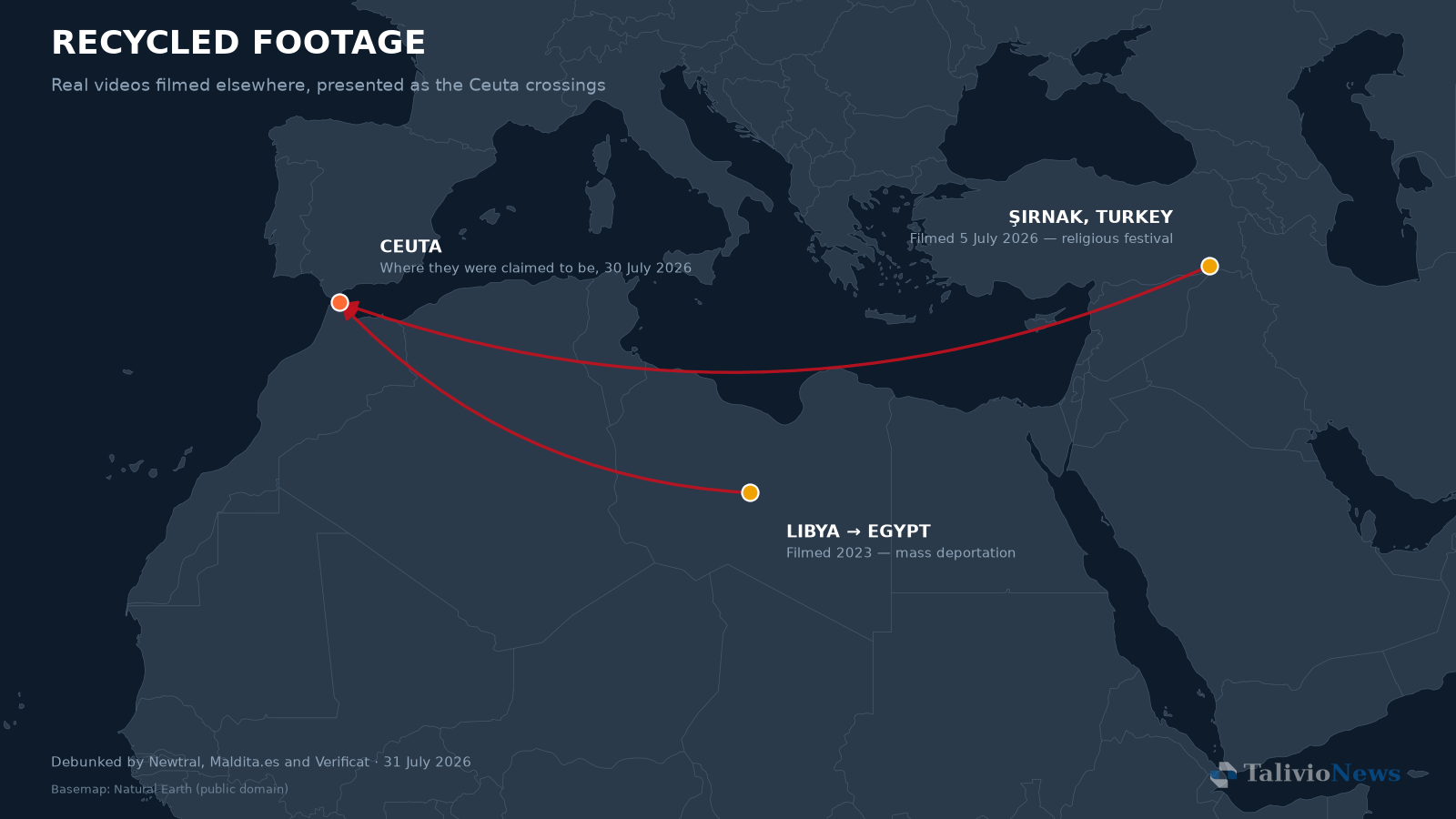
The surge in arrivals was accompanied by a wave of digital disinformation. A video shared as proof of a massive arrival of migrants in Ceuta on July 30, 2026, actually shows people traveling to a religious celebration on Mount Cudi in the Turkish province of Şırnak on July 5, 2026. A reverse image search located posts from the same user on TikTok and Instagram on that date, with original Turkish text reading 'Miles were on the right path, Mount Cudi'.
Other viral content was also misattributed. A video shared as a 'massive wave of migrants' on the way to Ceuta and as proof of an 'invasion of Europe' corresponds to a mass deportation of migrants from Libya to Egypt in 2023. Additionally, a video presented as Moroccan police deliberately opening a border gate had been circulating since at least May 18, 2026, and was geolocated to Plaza del Sortidor in Barcelona, Spain.
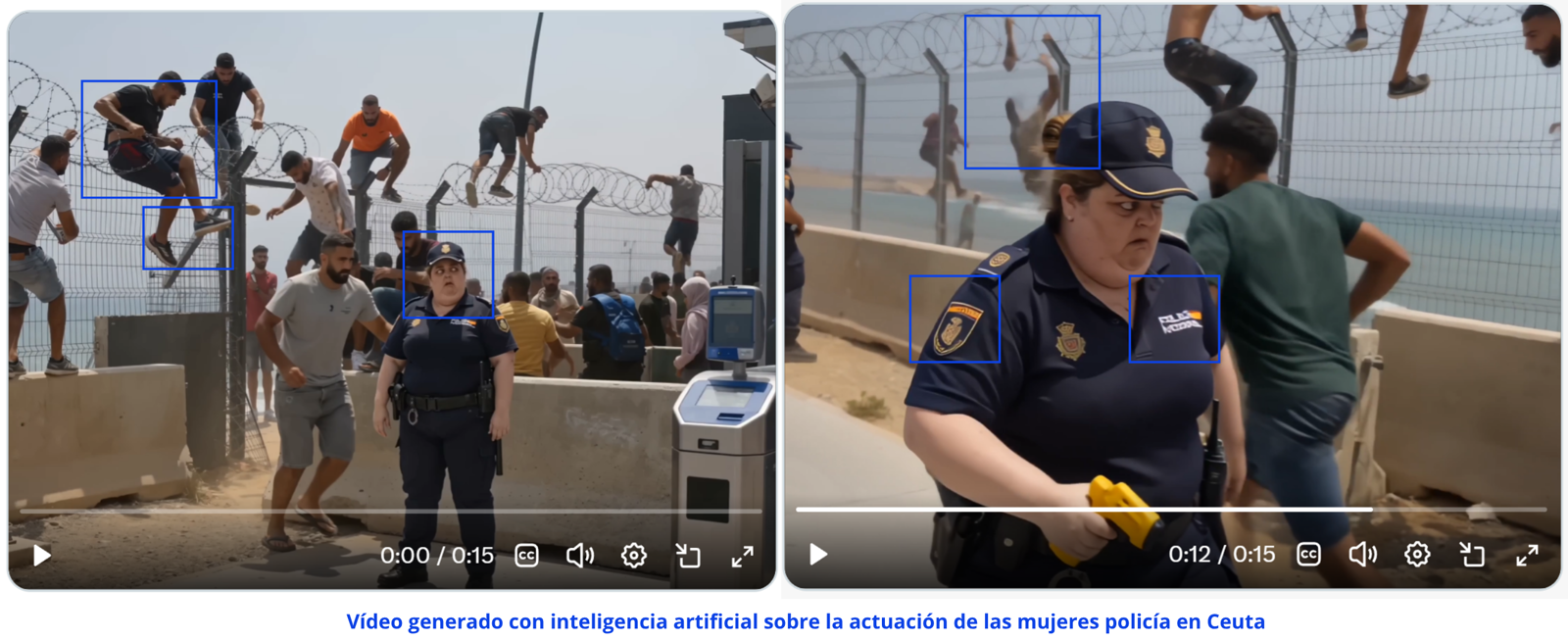
Artificial intelligence played a significant role in generating false imagery. Verificat identified several AI-generated videos that circulated during the crisis. One such video showed the Spanish Army deployed in Ceuta, but the uniforms carried the inscription 'Ejército Español' on the back, which does not appear on official Spanish military uniforms. Other AI-generated clips included a 'bacon squad' throwing strips of bacon at migrants, a policewoman using a taser on a passport holder while letting others through, and military personnel distributing food. These were detected by platform labels, inconsistent textures, deformed bodies, or lack of detail.
Verificat concluded that these AI-generated videos reinforce racist and misogynistic narratives, questioning the professional competence of policewomen and falsely suggesting preferential treatment by the state toward foreigners over Spaniards. Another modified infographic showed an expanded border wall extending kilometers into the sea.
Political Framing and 'Invasion' Rhetoric
The dramatic imagery shifted public discourse from neutral migration language to inflammatory terms such as 'invasion' and 'flood', advantaging far-right political messaging regardless of factual accuracy. Vox leader Santiago Abascal posted videos describing the migrant arrivals as an 'invasion' and blaming Prime Minister Pedro Sánchez’s government. He immediately labelled the arrivals an 'invasion of military-age men', helping normalise extreme language. One of his videos attacking immigration policy had 2.2 million views, while another calling Sánchez a 'traitor' reached 2.6 million views.
Looks like World War Z!
Elon Musk amplified this framing, sharing a video of the crossings with the caption above and calling the surge 'absolutely an invasion'. He also wrote on social media that 'Spain's entire budget will be destroyed by illegal migrants'. The Partido Popular’s claim that Spain's mass regularisation policy created a 'pull factor' encouraging migration is considered unfounded. Spain's extraordinary regularisation program had excluded anyone entering after January 1, 2026, required proof of five months of prior residence, and closed its application window on June 30, 2026.
Diplomatic Tensions and Conspiracy Theories
Migrants reported seeing Instagram posts falsely claiming a Spanish court ruling allowed automatic residency. Amid the crisis, claims that Israel was involved circulated in Spain, though they came from political commentators and lawmakers rather than the government. Journalist Jose Vizner revived a 2019 post by Yair Netanyahu about Israeli support for separatist movements in Ceuta and Melilla, asking if the pressure amounted to 'revenge' against Sánchez. ERC parliamentary spokesperson Gabriel Rufián echoed claims that the crisis served Israeli interests.
Spanish Transport Minister Óscar Puente responded to criticism by saying 'Well, things are starting to get pretty clear'. Observers interpreted this vague response as lending support to conspiracy theories about Israeli involvement. No Spanish government official formally accused Israel of weaponising the crisis. Israel's ambassador to the UN, Danny Danon, wrote on X that Spain 'still maintains colonial enclaves in Africa', but Israel's ambassador to Spain, Dana Erlich, stated that these comments do not represent the position of the State of Israel.
Regional Diplomacy and US Congress Report
Prime Minister Pedro Sánchez made his first visit to Algeria in six years on July 20, 2026, to restore bilateral relations after a crisis over Spain's position on Western Sahara. Sánchez and Algerian President Abdelmadjid Tebboune agreed to increase gas supplies to Spain, discuss cooperation in renewable energies, and hold a joint meeting in October 2026. Tebboune announced the reactivation of the Treaty of Friendship with Spain, which had been suspended. The diplomatic crisis between Spain and Algeria, opened in 2022, was considered resolved.
Internationally, the US House Appropriations Committee published a report in late April 2026 accompanying the National Security and State Department budget proposal for fiscal year 2027. The report’s section on Morocco states that Ceuta and Melilla, administered by Spain, are located on Moroccan territory and remain subject to Rabat's historical claim. Authored by Republican Congressman Mario Díaz-Balart, it is the first time a body of the US Congress has questioned in writing Spanish sovereignty over the two autonomous cities. The document is internal and not a binding US government position, but it suggests dialogue with Spain regarding the status of the enclaves.
Ceuta and Melilla are Spanish autonomous cities integrated into Spain since the 15th century and are not on the United Nations list of non-self-governing territories. They are enclaves on Morocco's Mediterranean coast whose sovereignty is claimed by Rabat but rejected by Madrid. Italian Foreign Minister Antonio Tajani said suspending the Schengen provision was 'a necessary choice to safeguard the security of our citizens'.