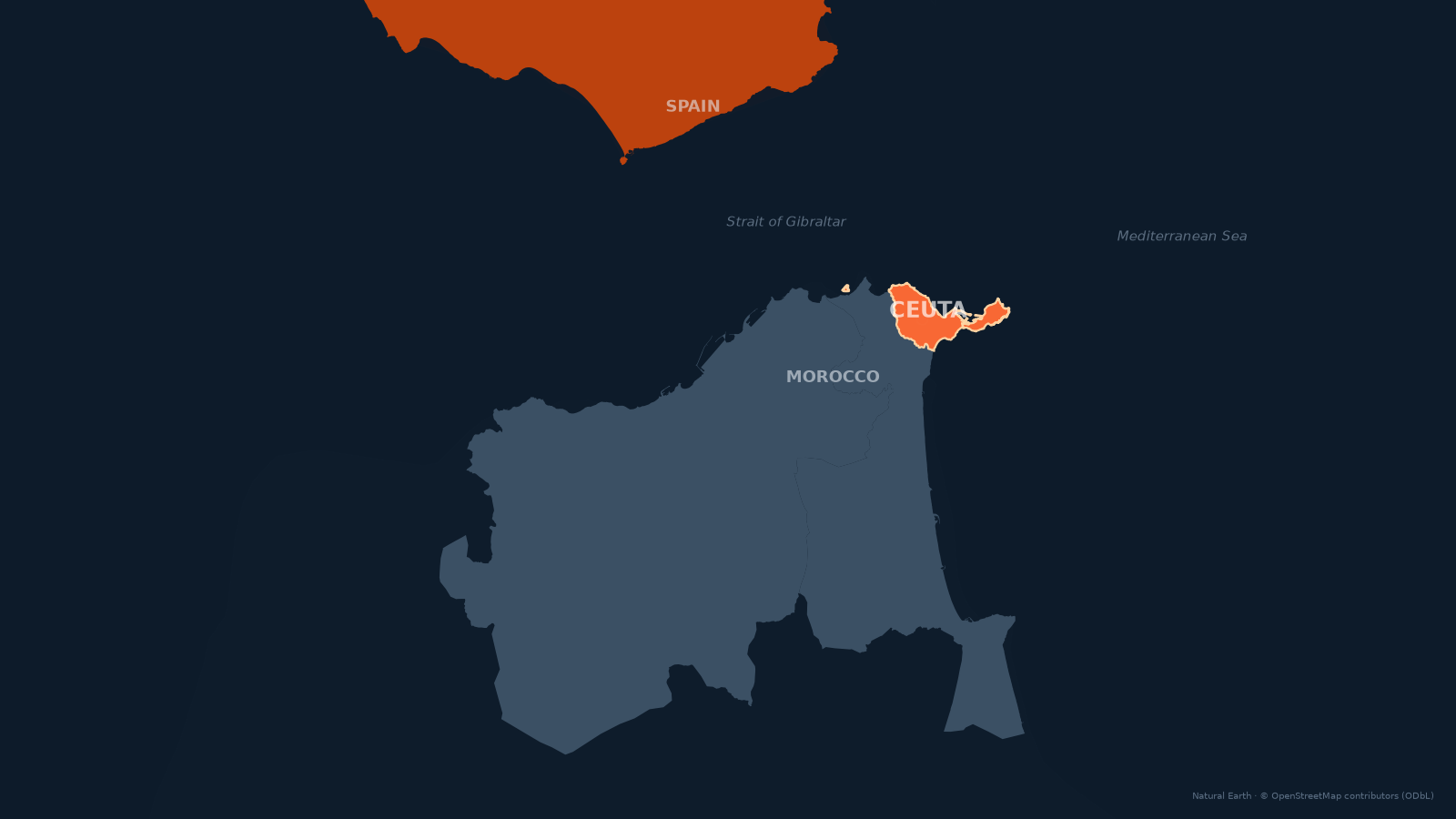
Since 30 July 2026, between 49,000 and 60,000 migrants have crossed from Morocco into the Spanish enclave of Ceuta within a 24-hour period, according to multiple sources. Spanish authorities reported over 49,000, while Ceuta's president estimated over 60,000, and other reports cited around 50,000.
This is the largest such surge since 2021, when around 12,000 people entered Ceuta during a previous crisis.
The reported number of people who crossed from Morocco into Ceuta in the 24-hour period starting 30 July 2026.
The death toll from the crossing is disputed. Some reports say at least 57 people died or were found on the Spanish side, while others report 19 deaths or 9 bodies recovered.
Government response
Spanish Prime Minister Pedro Sánchez described the surge as an 'ataque' ('attack') and a 'violación de la integridad territorial' ('violation of territorial integrity'). He also said the state would deploy every available resource to guarantee security.
Sánchez's government was 'fully committed to providing an immediate response' to the crossings, he said. Spain deployed military troops to Ceuta after the regional president urged Madrid to declare a national emergency.
By Friday afternoon, a majority of the migrants had returned to Morocco. Reports vary: more than 37,500 had returned by then per one source, while another says approximately 48,000 of the 50,000 returned.
International reaction
Italian Foreign Minister Antonio Tajani said he was 'in favour' of closing the Schengen free-travel zone with Spain, calling it 'a necessary choice to safeguard the security of our citizens.' Italy unilaterally suspended the Schengen agreement with Spain following the crisis.
Vox leader Santiago Abascal posted videos describing the arrivals as an 'invasion' and blamed Sánchez's government. Elon Musk also posted repeatedly, calling the surge 'absolutely an invasion' and writing that 'Spain's entire budget will be destroyed by illegal migrants.'
Absolutely an invasion
Israel's ambassador to the United Nations, Danny Danon, stated that Spain 'still maintains colonial enclaves in Africa' and should explain this before lecturing Israel. Israel's acting ambassador to Spain, Dana Erlich, distanced the Israeli government from these remarks, saying they do not represent the position of the State of Israel.
Spanish Transport Minister Óscar Puente responded to the criticism by stating, 'Well, it all seems to be becoming quite clear.' No Spanish government official formally accused Israel of weaponising the crisis.
Context and analysis
Sánchez visited Algeria on 20 July 2026 and agreed with Algerian President Abdelmayid Tebboune to increase gas supplies to Spain and reactivate the Treaty of Friendship, a diplomatic context that some officials have linked to the crisis.
A viral video claiming to show migrants descending toward the Ceuta border was actually recorded on 5 July 2026 in Şırnak province, Turkey, and depicted a religious festival in Mount Cudi.
Claims that Spain's regularisation program created a 'pull factor' are unfounded: the program excluded anyone entering after 1 January 2026 and closed on 30 June 2026.
Ceuta and Melilla are Spanish autonomous cities integrated since the 15th century and are not on the United Nations list of territories pending decolonisation, according to unverified reports.
The European Commission offered Frontex operational support to Spain during the crisis.
According to the EU Agency for Asylum, Moroccan citizens have a 6% recognition rate, meaning most Ceuta arrivals are likely to receive return orders to Morocco.