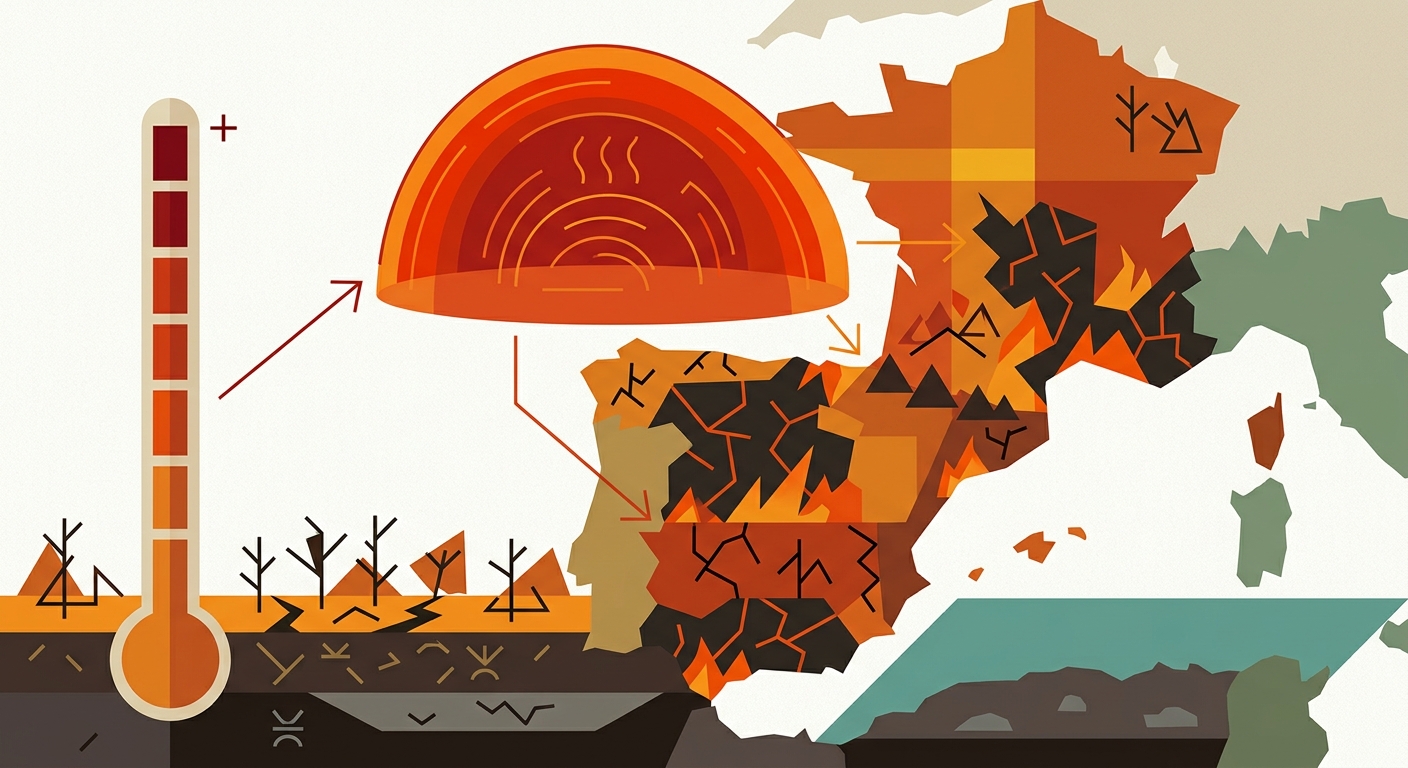
Human-caused climate change made the hot, dry and windy conditions that fueled this summer's wildfires in southwestern France at least twice as likely, and in central Spain at least 20 times as likely, according to a new analysis by the World Weather Attribution (WWA) group. Scientists described both figures as conservative estimates.
The fires displaced more than 250,000 people in France and Spain since early July. Since the start of the year, 140,000 hectares have burned in Spain and 115,000 hectares in France—each area larger than the Isle of Wight. Some blazes generated their own weather systems, making them hard to contain.
Researchers used the Daily Severity Rating—which combines heat, dryness, wind and landscape conditions—to measure fire difficulty. In today's climate, fire weather of this intensity can be expected once every 20 years in southwestern France and once every six years in central Spain.
Displaced by wildfires in France and Spain since early July
A pattern of wet winters followed by dry springs and summers is increasingly driving fire risk in the region. Spain had its wettest January in 25 years, followed by its hottest summer on record. France is suffering its fourth heatwave of the year.
These findings are extremely scary.
Clair Barnes of the WWA said the results show "forests loaded with dry fuel and relentless heat, fuelled by human-caused climate change." She added that what is unique about this case is that it is still early in the season.
The fires caused severe air pollution. In Bordeaux, France, fine particle pollution peaked at about 20 times the threshold for fair air quality. Poor air quality was recorded up to 400 km from the fires. Nearly 100,000 people in Spain were confined to their homes, and two towns west of Madrid were placed under lockdown for several days. In France, the national reserve of FFP2 masks was released to pharmacies for the first time during an air pollution episode.
Augustin Colette of the French National Institute for Industrial Environment and Risks said: "This summer 2026 sequence of compounding climate risks should be an eye-opener." He added that Europe's climate is shifting faster than governments are adapting.
Gareth Redmond-King of the Energy and Climate Intelligence Unit (ECIU) said: "Climate change doesn't light the spark for wildfires, but it certainly provides the fuel." He noted that the burning of coal, oil and gas has caused climate change, which has increased the planet's average temperature to around 1.4°C above pre-industrial times, according to the World Meteorological Organization.
The WWA group used historical weather observations to assess fire-prone conditions. Their report also notes that reducing wildfire risk requires risk-sensitive landscape planning and management. The likelihood of hot, dry weather that helps wildfires spread has increased sharply in Europe in recent decades.