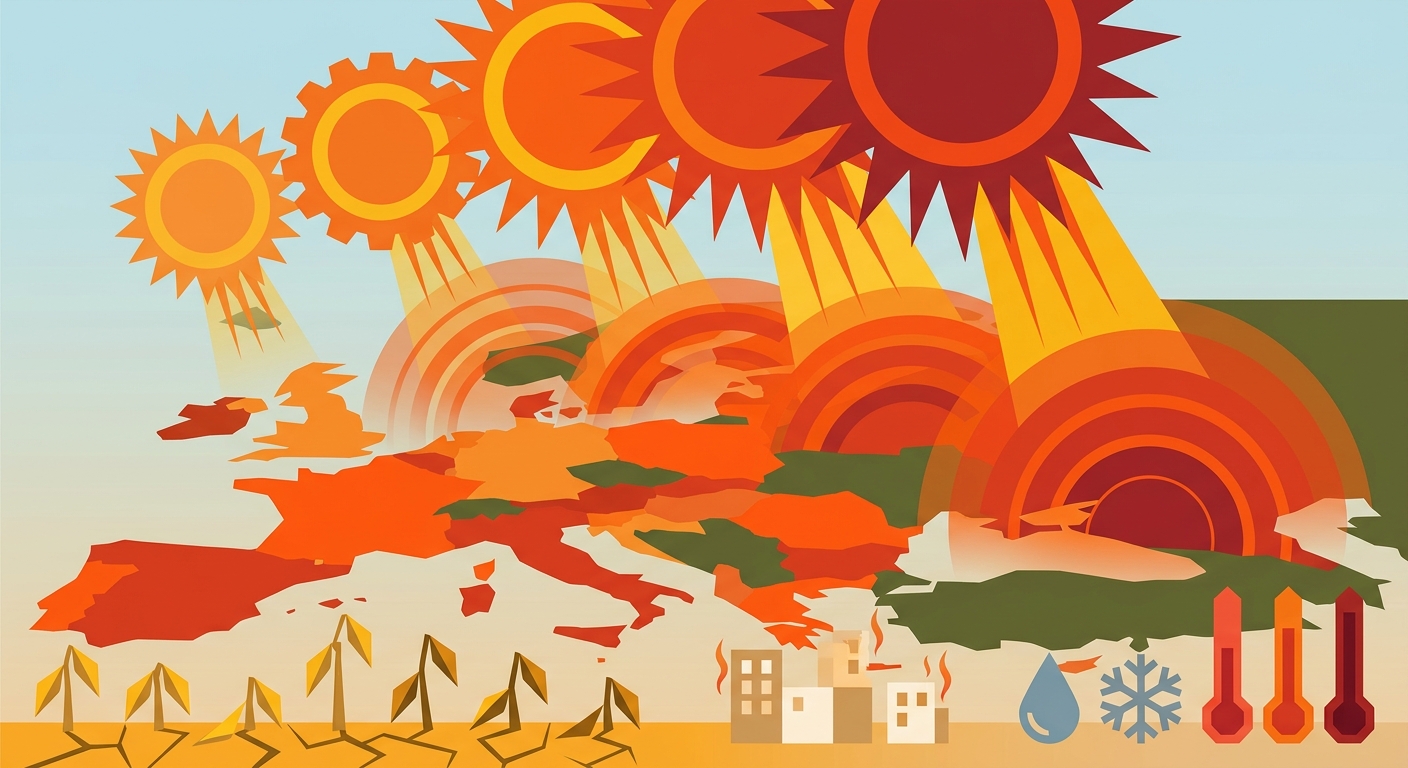
A new heatwave is set to affect wide areas of Europe this week, with temperatures in some regions approaching 40 degrees Celsius and reaching as high as 43 degrees Celsius (109 degrees Fahrenheit), according to the European Centre for Medium-Range Weather Forecasts (ECMWF) and European meteorological institutions. [source_ref:claim:1]
This is the fifth heatwave of a record-breaking summer for France and the UK. In France, temperatures are expected to rise rapidly, approaching 40 degrees Celsius in some areas, with high temperatures persisting all week, especially in the central and southern parts. The German Meteorological Service forecasts temperatures up to 37 degrees Celsius in parts of Germany, with Frankfurt expected to hit that mark on Friday. In the Netherlands, central regions could exceed 30 degrees Celsius, while the UK's south and central areas may see up to 36 degrees Celsius.
Highest forecast temperature in parts of Europe this week.
Belgium has issued a yellow alert for much of the country, where some cities may reach 35 degrees Celsius on Thursday and Friday. The heat comes amid widespread drought and low rainfall, with water levels in the Rhine, Danube, and Po rivers at historic lows. Low river levels are complicating freight transport and putting pressure on hydroelectric and nuclear power plants. In the UK, half of England and all of Wales are officially in drought, according to the UK Environment Agency. [source_ref:claim:14]
The dry conditions are increasing wildfire risk across Europe, particularly in France, Spain, and Italy. In France and Spain, more than 300,000 people have been forced to flee their homes due to wildfires, an operation ranked among the largest in Europe since World War II. AccuWeather estimates fires have cost up to £16.4 billion in economic damages, including emergency response, property damage, and health impacts. [source_ref:claim:42] [source_ref:claim:43]
The extreme temperatures also amplified widespread drought,
According to AFP calculations, areas of Europe home to at least 92 million people—particularly in France, Italy, and Spain—are set for temperatures over 35C on Wednesday. An analysis based on German weather service forecasts and population projections suggests temperatures will surpass 30C for about 300 million people in Europe on Wednesday, excluding Turkey. David Jablonski of the NGO Klimadashboard told AFP that the analysis likely underestimates the number affected in densely populated urban areas due to urban heat-island effects. [source_ref:claim:24] [source_ref:claim:25] [source_ref:claim:29]
Europe is the fastest-warming continent, with temperatures rising at about twice the global rate. July was the hottest month on record for nearly 120 million Europeans. The EU's Copernicus Climate Change Service reported a record-breaking 24-hour average temperature of 21.62C for June and July in Western Europe, which is 2.79C above the 1991-2020 average.
The heat has had severe impacts: more than 25,000 heat-related deaths have been reported in Europe this summer, and wildfires have scorched over 550,000 hectares. In France, a 20% shortfall in nuclear power generation was recorded due to drought, heat, and a jellyfish invasion clogging cooling pumps, according to Le Monde. Low river levels have forced the shutdown of nuclear plants in Hungary and Romania, according to reports on river reliance for cooling, and Poland's longest river, the Vistula, matched its record low in Warsaw, according to monitoring data. [source_ref:claim:20] [source_ref:claim:34] [source_ref:claim:50] [source_ref:claim:52] [source_ref:claim:51]
In the UK, the Met Office stated the country is on course for its warmest summer on record, with temperatures reaching the mid-30s Celsius in some places. The UK National Farmers Union has warned that continuing dry weather could lead to food shortages, and the Met Office noted that northwest Scotland received more than half a month's rainfall in just two days.