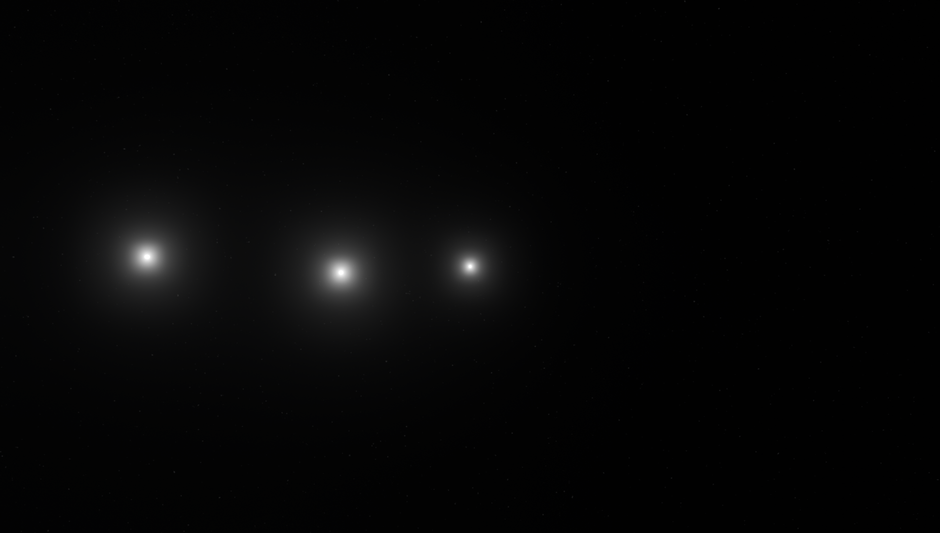
NASA's Neil Gehrels Swift Observatory has captured an 'orphan' black hole lighting up as it devoured a star on the outskirts of a faraway galaxy. The phenomenon, called a tidal disruption event, is rare and none had ever before been seen so far outside of a galaxy's core.
A paper describing the results, led by Robert Stein, was published in The Astrophysical Journal Letters.
The black hole's existence was first flagged in November 2025 by the Zwicky Transient Facility (ZTF) at Palomar Observatory in Southern California. The galaxy is about 750 million light-years away. ZTF detects half a million flashes each night.
Swift's UVOT instrument measured the temperature at about 54,000 degrees Fahrenheit (30,000 degrees Celsius). Jonathan Carney, a doctoral student at the University of North Carolina at Chapel Hill, took the first spectra supporting the flare's interpretation as a tidal disruption event.
Nearly every galaxy in the universe is anchored by a supermassive black hole at its center. About once every 100,000 years, a star triggers a tidal disruption event in a given galaxy. Each year, astronomical surveys spot about 30 such events somewhere in the universe.
Prior to 2024, tidal disruption events had only been seen in galaxy cores. Recent events include a star shredded 2,600 light-years from its host galaxy's center, and another more than 30,000 light-years away. The researchers outlined two possibilities: three or more galaxies may have merged and flung the black hole out, or a dwarf galaxy is merging and a star passed too close to its supermassive black hole.
Swift's primary mission ran from 2004 to 2006, and it is slowly sinking toward Earth due to atmospheric drag. An orbit boost could extend Swift's lifetime. Future surveys by the Vera C. Rubin Observatory in Chile and NASA's Nancy Grace Roman Space Telescope will search for more tidal disruption events.