Roughly 18.5 million people in Turkey use X, the platform formerly known as Twitter — about 21.1 percent of a population of 87.7 million, according to DataReportal's Digital 2026 country report. It is not the country's biggest social network: Instagram reaches more than three times as many people there, TikTok more than twice as many. Yet for over a decade this one platform has set the rhythm of Turkish political life. What trends on X in the morning is debated on television by night.
That agenda-setting power has been manufactured to a degree unusual even by the standards of modern information operations. Peer-reviewed research found that at least 47 percent of Turkey's top-5 trending topics in one measured period were fake — created by coordinated bot networks, not by any real conversation. One of the best-documented cases of a platform removing an operation linked to a governing party happened on Turkish Twitter. And the only itemized price list for coordinated social media influence ever to surface in a Turkish courtroom appeared in November 2025 — in an indictment aimed not at the government's networks, but at the opposition's.
This special report assembles what is documented, what is alleged and what can honestly be estimated about the machinery of manufactured visibility in Turkey — and attaches a clearly labeled cost estimate to it, built from court records and field research rather than guesswork.
The documented core: 7,340 accounts, 37 million tweets
On June 12, 2020, Twitter announced it had permanently removed 7,340 accounts operating in Turkey, publishing all of them to its archive of state-linked information operations. In the company's words, this was a collection of "fake and compromised accounts" used to "amplify political narratives favorable to the AK Parti", Turkey's ruling Justice and Development Party. Technical signals, Twitter said, pointed to the network "being associated with the youth wing of the party".
Removed by Twitter on June 12, 2020 and attributed to a network associated with the ruling party's youth wing. Together they had posted 36,948,524 tweets.
The Stanford Internet Observatory, which received the dataset from Twitter, described a centrally managed operation built on two pillars. The first was batches of fabricated personas, many created on the same day with similar usernames. The second was hijacked reality: compromised accounts — including some belonging to organizations critical of the government — taken over and repurposed for pro-government messaging. Stanford's researchers documented organized retweet rings with names like AK Davam and AK Hilal; seventeen AK Hilal accounts alone produced 128,257 tweets, 98.6 percent of them retweets. Across the archive, President Recep Tayyip Erdoğan's account was mentioned or retweeted 1.7 million times. The network attacked the opposition CHP and the pro-Kurdish HDP, promoted the 2017 constitutional referendum and pushed support for Turkey's military operations in Syria — aimed, in Twitter's assessment, primarily at domestic audiences.
The government's response was not silence. Fahrettin Altun, then head of the Presidency's Directorate of Communications, called Twitter "a propaganda machine with certain political and ideological inclinations" and dismissed the supporting research as "unscientific, biased and politically motivated". The takedown remains a platform attribution, contested by the government and never tested in any court. But it is the single best-documented event in the history of Turkish social media manipulation — and it remains the only Turkey-attributed disclosure in the platform's state-operations archive that TalivioNews could identify. No Turkish official has been prosecuted, or even formally investigated, in connection with the network Twitter described.
The measured distortion: trends built from deleted tweets
What the takedown showed in one snapshot, academic research has measured over years. In a study presented at the IEEE European Symposium on Security and Privacy in 2021, researchers at Switzerland's EPFL — led by Tuğrulcan Elmas — described a technique they named ephemeral astroturfing: bot accounts mass-post algorithmically generated gibberish tweets containing a target keyword, then delete them within seconds. Twitter's trending algorithm counted the deleted tweets anyway. The keyword enters the trend list; the evidence evaporates.
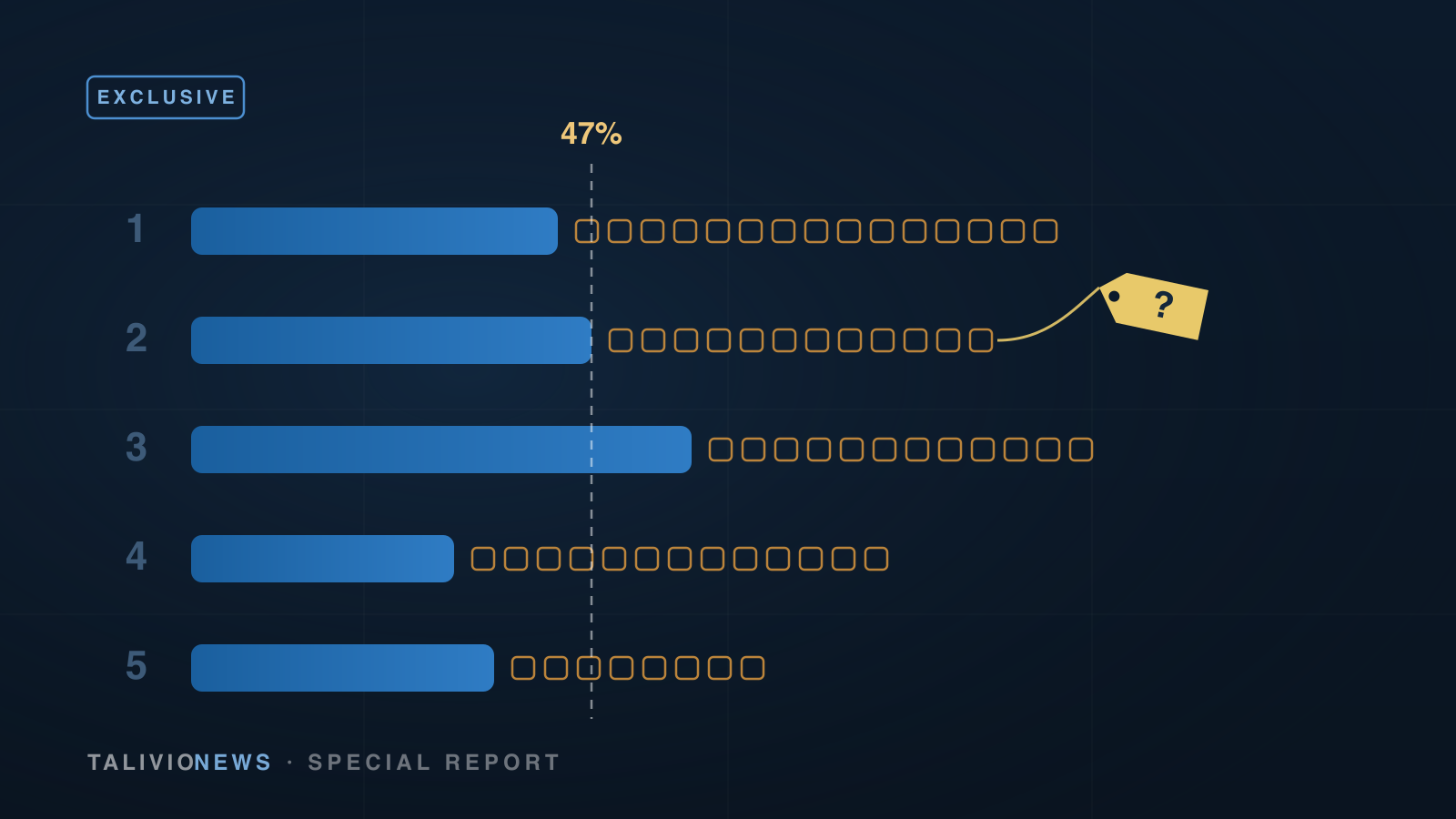
The scale of the finding is startling. The researchers detected more than 19,000 unique fake trends pushed by over 108,000 accounts, and concluded that such attacks accounted for at least 47 percent of Turkey's top-5 daily trending topics in the measured period. On the worst single day, the share reached 68.4 percent. For years, in other words, the apparent national conversation was on many days mostly synthetic.
Minimum share of Turkey's top-5 daily Twitter trends created by coordinated fake-tweet attacks, per EPFL research presented at IEEE EuroS&P 2021. On the peak day the share reached 68.4 percent.
A follow-up study presented at the ACM Web Conference in 2023 tracked more than 212,000 bots targeting Turkish trends and found the platform had purged them en masse six times since June 2018 — after which operators simply activated new bots, many of them aged accounts created years earlier and left dormant. Reporting in 2024, citing the same researcher, found the fake-trend industry alive in the X era, with social media agencies openly advertising trend-setting as a service.
International classifications add context — and one correction to the popular narrative. The Oxford Internet Institute's global inventories of state-linked manipulation place Turkey in the middle tier of capacity, not the top one. Its 2019 report described a permanent team with size estimates of around 500 people; its 2020 report, Industrialized Disinformation, classified Turkey's capacity as medium, with somewhat centralised coordination. On the documented evidence, Turkey's operation is not in the league of Russia's or China's global apparatus. What makes the Turkish case stand out is something else: how much of the effort is aimed inward, at the country's own citizens.
From Gezi to an institution
The machinery has a birthday. In September 2013, three months after the Gezi Park protests — organized substantially over Twitter — the AKP announced it was forming a social media team of more than 6,000 members, styled social media representatives, with about 1,000 staff in Istanbul, 600 in Ankara and 400 in İzmir. Hürriyet Daily News reported at the time that the team's task was converting party sentiment into trending hashtags. The recruits were described as volunteers, not salaried employees — a distinction that still matters to anyone trying to estimate what the system costs.
Emails leaked in 2016 from the account of Berat Albayrak — then energy minister and President Erdoğan's son-in-law — and published by WikiLeaks as a 57,934-message archive suggested a more professional layer. According to reporting on the leaks, a June 2013 proposal sent to Albayrak envisioned a team of graphic designers, coders and former army officials trained in psychological warfare. Albayrak has never confirmed the emails' authenticity. Later accounts — an ex-insider interviewed in Turkish media, opposition politicians, think-tank analyses — describe a New Turkey Digital Office established around 2015, and troll payments routed through private companies doing business with AKP-run municipalities. None of those funding claims has ever been tested in court; they remain allegations. By 2023, Freedom House's Freedom on the Net report put the pro-government army of trolls at around 8,000 individuals.
What is not an allegation is the growth of the state's overt persuasion apparatus. The Presidency's Directorate of Communications, created in 2018 and led for seven years by Altun before Burhanettin Duran took over in July 2025, has a public budget line: 4.13 billion lira in 2024; 6.16 billion allocated for 2025 — a year in which it had already spent 6.67 billion by the end of November, the highest expenditure in its history; and 7.56 billion lira, roughly 175 million US dollars, for 2026.
The Directorate of Communications' 2026 budget — roughly 175 million US dollars, and an 83 percent rise over its 2024 budget of 4.13 billion lira. This is the state's overt, lawful communications spending; no public budget line for covert influence operations has ever been identified.
Inside the directorate sits the Center for Combating Disinformation, known by its Turkish initials DMM, announced in August 2022. Its bulletins overwhelmingly correct claims that embarrass the government: Turkey's press ombudsman Faruk Bildirici has observed that it corrects opposition-aligned media while leaving errors in pro-government outlets unaddressed. In August 2024 the Constitutional Court annulled the presidential-decree basis of the directorate's strategic communication department; the center kept operating. Two months after the DMM's launch, parliament passed what critics call the censorship law: Article 217/A of the penal code, criminalizing the public dissemination of misleading information, with prison terms of one to three years. The Council of Europe's Venice Commission had urged Turkey to withdraw the draft, warning of its chilling effect. In its first two years, Article 217/A generated 4,188 investigations against 4,590 people — and 12 convictions. By April 2026, press freedom groups counted at least 83 journalists charged 114 times under it.
The asymmetry is the point. In today's Turkey, disinformation is a crime prosecuted energetically when the suspected speaker is a journalist or an opposition voice. The pro-government networks documented by Twitter, Stanford and EPFL have never been the subject of a Turkish criminal investigation that TalivioNews could identify.
The only money trail runs through an opposition indictment
Which makes the one existing price list all the more striking. On November 11, 2025, Istanbul prosecutors unveiled a roughly 3,900-page indictment against jailed Istanbul mayor Ekrem İmamoğlu and 401 other defendants, seeking up to 2,352 years in prison for the mayor, who denies all charges. Buried in it, based on reports by MASAK, Turkey's financial crimes board, is a claim that a consultancy called Karpuz Danışmanlık — controlled, prosecutors say, by fugitive suspect Emrah Bağdatlı — funneled a total of 13,237,500 lira between 2021 and 2025 to a set of high-follower social media news accounts, in exchange for favorable coverage allegedly coordinated through WhatsApp groups.
The indictment itemizes the alleged payments: 2,580,000 lira to Pusholder Medya; 2,280,000 to BPT Haber; 1,860,000 to BT Yeni Medya, operator of the Boşuna Tıklama account; 1,680,000 to Batuhan Çolak, founder of the Aykırı account; and smaller sums to five further recipients, down to 180,000 lira to Serkan Kafkas of Ajans Muhbir. Every figure is a prosecution allegation, not a court finding. CHP leader Özgür Özel has called the case "not legal — it is entirely political". BPT has publicly denied any wrongdoing; Ajans Muhbir has said it was targeted with baseless accusations. And several of the named accounts are nationalist in orientation rather than aligned with the opposition CHP — one reason the picture of a coordinated opposition PR network is contested.
There is a further irony in the list. In the spring of 2025, several of the same accounts — BPT, Boşuna Tıklama, Etkili Haber, Zam Haber and Ajans Muhbir among them — were blocked in Turkey at the request of the very same Directorate of Communications, under the national security article of the country's internet law. The same news accounts appear simultaneously in a prosecution narrative as paid opposition assets and in the state's own censorship record as threats to national security.
On the other side of the ledger, pro-government media spent July 2026 amplifying a claim that the CHP under Özgür Özel had paid roughly 775 million lira to troll accounts and aligned media. The source is not a prosecutor or an audit: it is a single statement by Ali Haydar Fırat, a CHP figure, on a YouTube program — and the figure mutates between 755 million, 775 million and 953 million depending on the outlet repeating it. One named recipient publicly denied the claim and demanded evidence. No court document supports it.
And that is the entire documented money trail. There is no indictment, no MASAK report, no audit — nothing with legal force — that has ever put a lira figure on the pro-government networks that Twitter attributed to the ruling party's own youth wing. The only financial anatomy of Turkish social media manipulation to reach a courtroom is the one aimed at the government's opponents.
The lists everyone shares, and the evidence nobody has
On Turkish X, lists circulate constantly: dozens of news-style accounts accused by users of acting in concert — publishing the same stories within minutes of each other, staying uniformly silent on stories that embarrass the government, surging in unison behind chosen hashtags. Some accounts named in the 2025 indictment appear on those lists; so do many others. The behavioral pattern is real and observable, and simultaneous publication is well documented in screenshots.
But observed synchrony is not proof of a controller. Accounts feeding from the same agencies and the same viral sources will often post the same things at the same times. The recurring claim that these accounts are run or coordinated by the Directorate of Communications is, on the public record, unproven: no leak, no court file and no independent investigation has established it. TalivioNews has seen no evidence that any specific named account operates under state direction, and this report does not claim otherwise. What the record does show is the pattern established by platform disclosures and peer-reviewed research: manufactured trends, coordinated amplification, and one documented state-linked network — attributed, in 2020, not to a ministry but to a party youth wing.
What would it cost? An estimate, labeled as one
No researcher, journalist or institution has ever published a total figure for what Turkey's coordinated social media operations cost. TalivioNews searched for one; it does not exist. What do exist are anchors — documented prices from the world's best-audited influence operations, and Turkey's own labor market — from which a range can be built honestly, provided it is labeled for what it is: an estimate.
The gold standard of documentation is Russia's Internet Research Agency. A United States federal indictment put the St. Petersburg troll farm's monthly budget at over 1,250,000 dollars by September 2016; a second court filing counted more than 35 million dollars in proposed budgets for the wider Project Lakhta between January 2016 and June 2018, with actual expenses of roughly 12 million dollars a year. Individual trolls there earned about 777 dollars a month in 2015. In the Philippines, field research found fake-account operators paid around 235 dollars a month — 20 dollars a day — while PR firms charged 38,000 to 57,000 dollars for month-long campaign retainers. Saudi operatives were reportedly offered about 3,000 dollars a month. China runs the opposite model: a Harvard study estimated about 448 million fabricated posts a year, produced largely by existing government employees as part of their jobs — a cost hidden inside ordinary payrolls rather than paid out in cash.
Turkey's documented scale sits between these poles. The network Twitter removed held 7,340 accounts; academic tracking counted 212,000 trend-attacking bots over several years; Freedom House put the troll army at around 8,000 people as of 2023, up from the roughly 6,000 announced in 2013; Oxford researchers estimated a core team of about 500. Turkey's net minimum wage in 2026 is 28,075.50 lira a month — about 655 dollars. Allegations reported in Turkish media as far back as 2014 described monthly troll payments of 800 to 4,000 lira; they were never officially confirmed.
Two reference points bracket that range. When X's own chatbot, Grok, was asked to guess — in the exchange of user questions that prompted this investigation — it produced a range of 500,000 to 1.2 million dollars a month. That falls inside our band, but a language model's guess corroborates nothing: in TalivioNews's earlier Ceuta investigation, Grok confidently flagged the Spanish government's own verified casualty figures as misinformation. The other reference point is real. The overt budget of the state's communications apparatus — 7.56 billion lira for 2026, roughly 175 million dollars — means that even the top of our estimated range for covert influence would amount to less than a seventh of what the state openly spends on communication in a year.
A machine that does not need to persuade
There is an apparent paradox in all this spending. X reaches about a fifth of Turkey's population, and only 23 percent of Turks use it for news in a given week, according to the Reuters Institute's Digital News Report 2025. No reliable measurement of the party-political composition of Turkey's X users exists — TalivioNews found none, and the closest academic mapping, a 2025 study that classified 481,041 Turkish accounts by ideology, charts geography and ideological axes rather than party shares. But nobody describes the platform as a pro-government stronghold: it was the infrastructure of the Gezi protests, and it is where opposition-leaning outlets enjoy Turkey's highest brand-trust scores while pro-government brands score lowest. Why pour resources into manufacturing majorities in a room where your own supporters are, at best, a minority of a fifth of the country?
The research answer is that persuasion was never the product. The Oxford Internet Institute's 2020 inventory codes Turkey's operations for exactly three things: pro-government propaganda, attacks on the opposition, and suppression — a category it defines as suppressing participation through trolling and harassment. A content analysis cited in the peer-reviewed study Digital Populism found that Turkish political troll output consisted overwhelmingly of insults and threats — threats of violence alone made up 72.4 percent of it — not arguments. That study's conclusion about the troll army's strategies fits in one line: they "ultimately aim at silencing the public sphere". A fake trend does not need to convince anyone. It needs to bury a real one, exhaust a critic, and hand the evening's talk shows a manufactured agenda.
There is also a political-economy answer, and it reframes the cost question entirely. A substantial body of political science research describes the ruling party's durability as built less on persuasion than on distribution. A study of 49,355 high-value public contracts awarded between 2004 and 2011 found that firms connected to the ruling party won 40 percent of them — and three-quarters of the contracts awarded through restricted, less competitive procedures. Research on TOKİ, the state housing agency, found that the probability of the AKP winning three consecutive local elections rose from 18 percent in districts with no TOKİ housing to 62 percent in those with the most. One peer-reviewed study describes the construction of "a loyal business class through an elaborate system of rewards and punishment"; another found social assistance flowing disproportionately to electorally contested provinces.
Read together — and this is TalivioNews's analysis, not a documented finding — the two bodies of evidence describe a machine whose loyal audience is, to a meaningful degree, bound by interest rather than argument, and whose online arm was never a persuasion budget in the first place. In that reading, the genuinely persuadable audience behind Turkey's manufactured trends is small, and the operation's real products are noise, intimidation and the appearance of consensus. Even the troll workforce belongs to the same economy: reporting has long alleged that trolls were salaried through municipal contractors, and the Digital Populism study relays claims that successful trolls were rewarded with public tenders. Seen this way, the troll economy is not a marketing expense that must justify itself in converts. It is a small province of the rent economy it defends — a governance cost, paid to keep the appearance of majority intact on the one platform the government never fully captured.
What a labeled simulation predicts
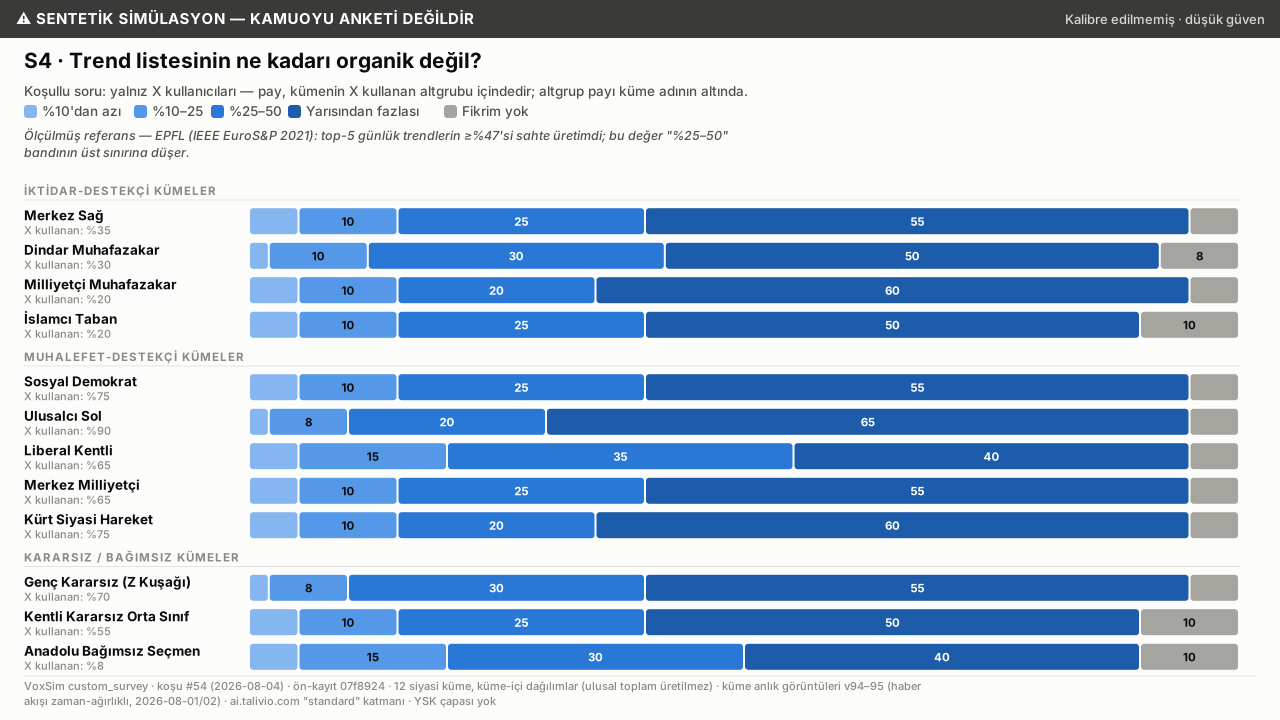
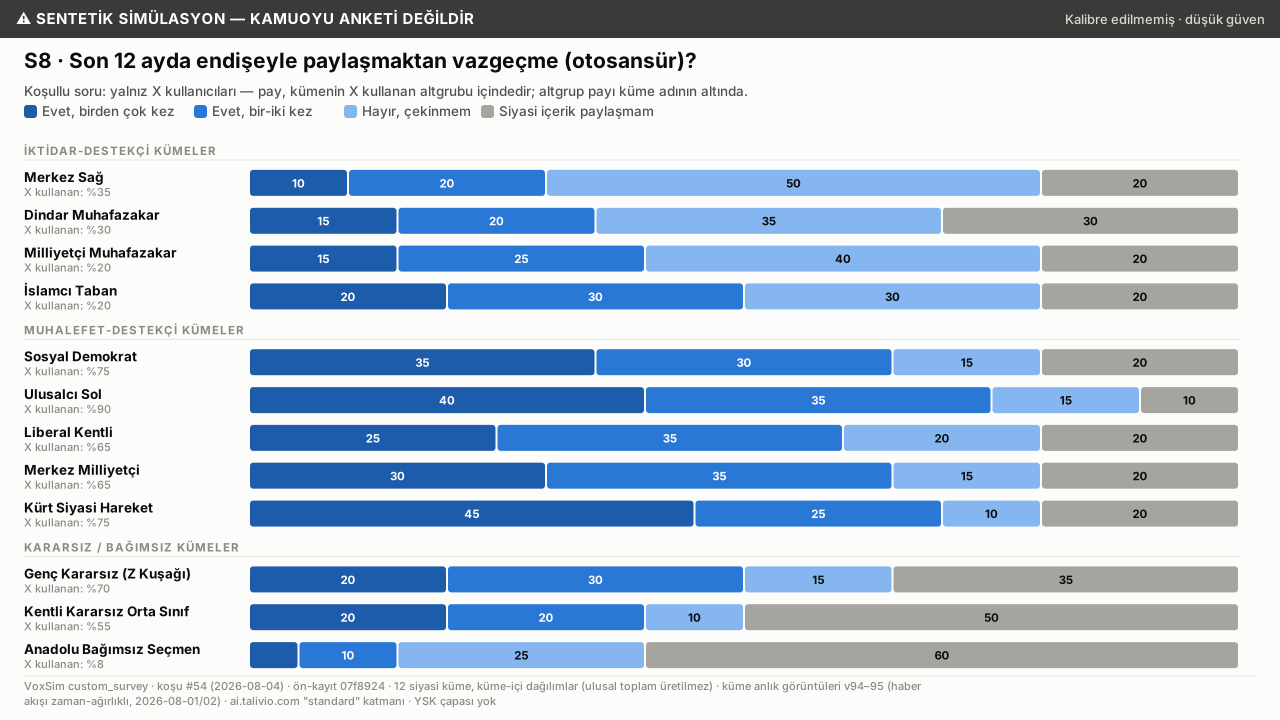
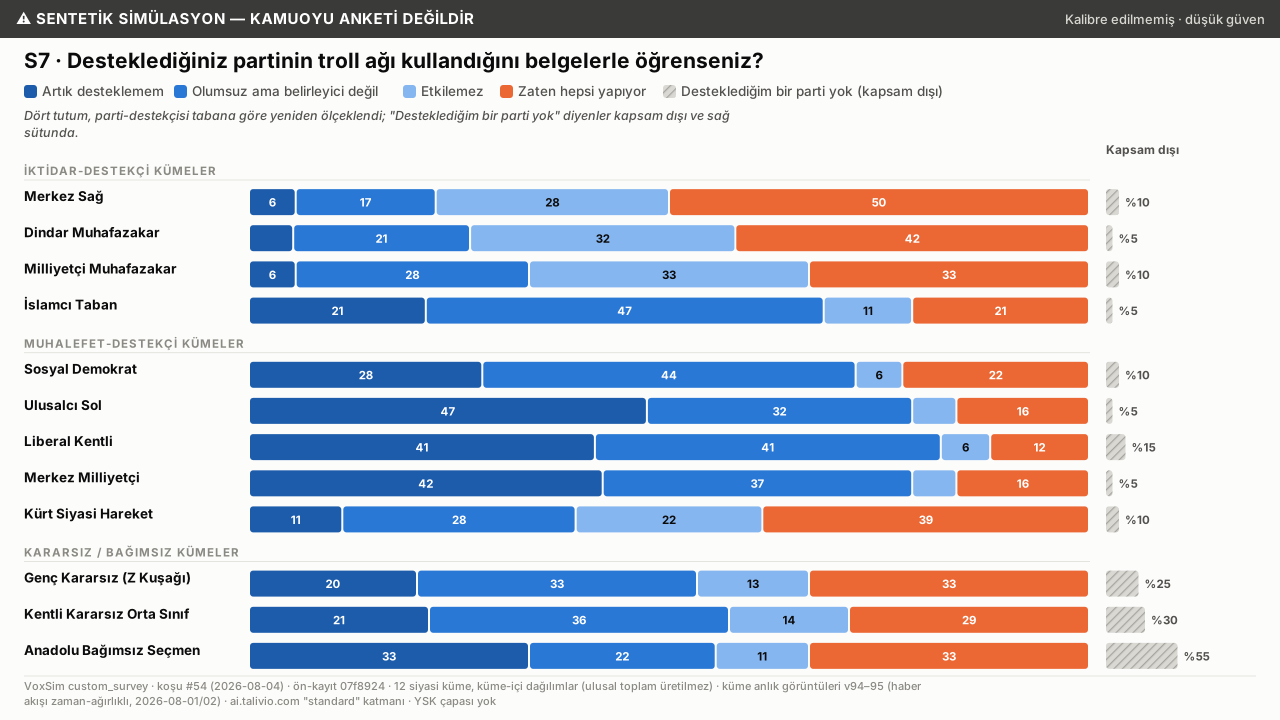
This report carries one more data layer, and it is synthetic by design. VoxSim, Talivio's LLM-based synthetic society simulation, models Turkey's political map as 12 political clusters, each fed by its own media diet through dated snapshots of the news stream. At our request it simulated an 11-question perception survey about the troll economy. This is not an opinion poll: no human was interviewed, the output is uncalibrated, and every chart carries the label saying so inside the image itself. The question list was frozen by pre-registration before the run — commit 07f8924598d13ce6d2a976dc757e5b8f102ecc70 — and every returned result is published, none withheld. It is here precisely because of this file's thesis: the difference between labeled synthetic opinion and unlabeled synthetic consensus is the entire point. And since this article is about costs nobody discloses, we disclose ours: the full simulation run cost 0.049 euros.
The simulation's starkest prediction is unanimity of distrust. In no cluster do more than 5 to 10 percent of simulated X users say the trending list largely reflects Turkey's real agenda. Asked what share of trends is not organic, every one of the 12 clusters — government-aligned ones included — puts 40 to 65 percent of its simulated users at "more than half": perception at or above the 47 percent floor that EPFL actually measured for top-5 trends. If the simulation is directionally right, the manufactured consensus machine operates on an audience that already assumes the trends are manufactured.
The suppression thesis gets its sharpest illustration in the self-censorship question. Across clusters, between 30 and 75 percent of simulated X users report having withheld a political opinion at least once in the past year out of fear of coordinated pile-ons, being singled out, or legal consequences — highest in the nationalist-left and Kurdish political clusters, lowest in the centre-right. The disinformation-law question splits along the expected fault line: in opposition-leaning clusters, 60 to 75 percent of simulated users say Article 217/A in practice targets critical voices; in religious-conservative clusters, 60 to 70 percent say it targets real disinformation, and only 5 to 10 percent say it targets critics.
The exposure question — what would you do if you learned, with credible documents, that a party you support runs a paid troll network — produces the asymmetry this file documents elsewhere in perception form. The "I would no longer support them" answer peaks in opposition-aligned clusters at up to 45 percent; the normalization answer, "they all do it anyway", peaks in government-aligned clusters at up to 45 percent as well, with the party-less escape option absorbing 5 to 55 percent depending on the cluster. In the simulation's reading, exposure is costly on one side of the aisle and largely priced in on the other.
Where the simulation touches measured reality, it lands directionally right — its universal trend-distrust echoes the Reuters Institute's finding that only 33 percent of Turks trust news — but its limits are part of the record: simulated X-usage shares per cluster run from 8 to 90 percent, far above the roughly 21 percent national penetration, because the clusters model the politically engaged. Per-cluster confidence scores range from 75 to 87, and the output remains uncalibrated. The full distributions for all 11 questions, the remaining charts and the complete method are public.
On many days, the apparent national conversation was mostly synthetic.
That may be the most revealing thing about Turkey's troll economy. The visible budget grows year after year in the official gazette; the invisible one is legible only through foreign courtrooms, platform archives and academic forensics. About a fifth of the country is on X. What that fifth sees when it opens the trending list is, on the documented record, partly a product — assembled by networks whose existence has been established by platform disclosures and peer-reviewed research, and whose price has never once been disclosed to the public that pays, in one way or another, for it.