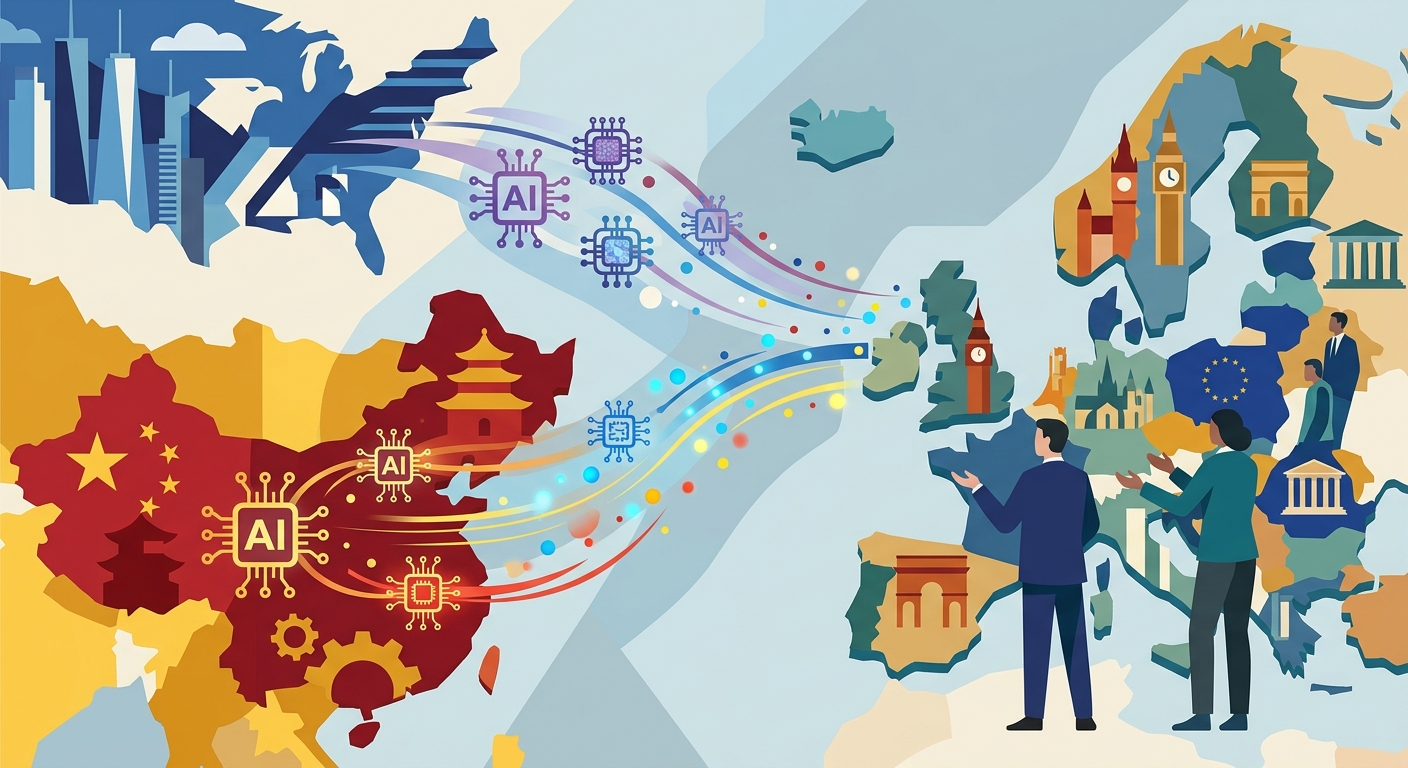
The United States and China are consolidating their dominance in artificial intelligence, raising questions about whether Europe can carve out a distinct third pole or remain in Washington's technological orbit. The market for powerful foundation models is today predominantly shaped by providers from these two nations.
Through the use of AI, large amounts of data – valuable raw materials vital for a modern economy – are sent to the US and China every second. Europe is dependent on the US and China for AI, a structural reality that critics argue lacks a political strategy for change.
European politics has no plan to change Europe's AI dependency.
Innovation indices highlight the gap
The 2026 Global AI Innovation Index, produced by China's Institute of Scientific and Technical Information and Peking University, assessed 46 countries' AI innovation and development. The index placed the US first with 78.44 points and China second with 60.49 points.
Britain placed third in the index with 39.99 points, more than 20 points behind the US. Germany placed sixth and France placed seventh, illustrating the distance between major European economies and the leading AI powers.
Model production and supply chains
Stanford's 2026 AI Index Report reported that the US produced 59 notable AI models last year, while China credited with 35. Europe was credited with only two notable AI models in the same period.
Experts warn that Germany and Europe will not be able to counter the current large general-purpose models in the short term with a comparable budget and similar computing power.
In June, Washington signed up 10 more partners for its Pax Silica framework, bringing the total to 24. The framework is designed to secure supply chains for key advanced technologies such as microchips and AI.