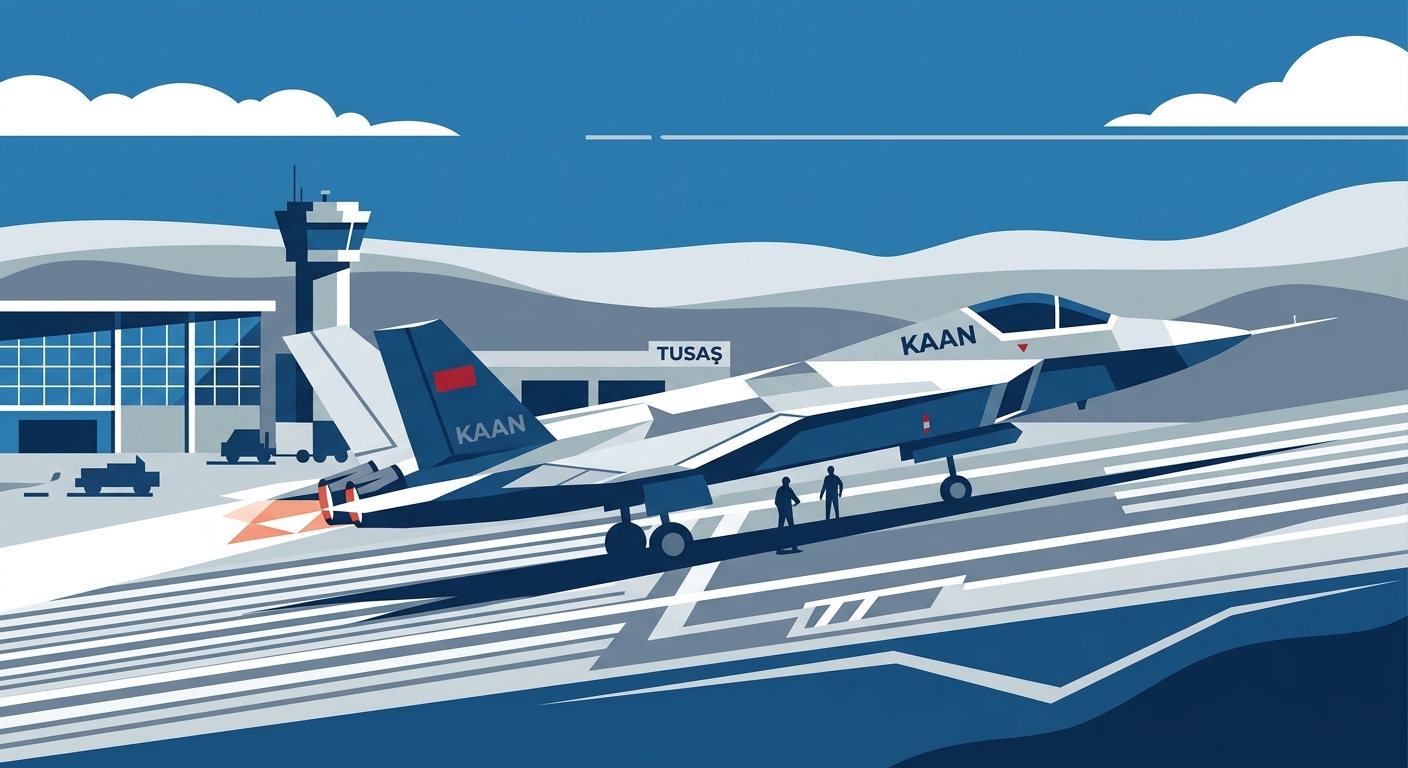
Turkish Aerospace Industries (TUSAŞ) released new footage on Friday showing the taxi tests of the KAAN national combat aircraft's new prototype.
These low-speed taxi tests are designed to measure the performance of these components before moving to high-speed taxi tests and flight trials.
The KAAN-1 prototype incorporates a series of innovations ranging from its fuselage structure to its avionics architecture. Engineers are currently making aerodynamic performance-enhancing updates to the prototype and completing the integration of internal systems with the aircraft's main architecture. The KAAN-1 was shaped based on flight data obtained from the KAAN-0 prototype.
Technical specifications and program goals
Developed for the Turkish Air Force, KAAN is a 5th generation multi-role combat aircraft designed for both air-to-air and air-to-ground combat missions. The aircraft features a twin-engine structure, a single-seat cockpit, and the capability to cruise at supersonic speeds.
The aircraft's design includes low radar visibility, internal weapons bays, increased air-to-air combat range, and high maneuverability. It is also equipped with advanced avionics architecture, sensor fusion, enhanced situational awareness, electronic warfare capability, and AI-supported combat systems. Additionally, it can network with unmanned aerial vehicles (UAVs) and airborne early warning and control (AEW&C) aircraft for joint operations.
Length of the KAAN aircraft
The KAAN aircraft measures 21 meters in length, 14 meters in wingspan, and 6 meters in height.
Prototypes and flight testing
Testing and development activities are continuing with the P1 and P2 prototypes, which feature a more advanced systems architecture. These prototypes are also identified as KAAN-0 and KAAN-1.
The flight tests for the KAAN P1 prototype are expected to begin in the coming weeks, while the P2 prototype's flight tests are expected to begin towards the end of the year. Two KAAN prototypes are targeted to fly together towards the end of the year.
The program's multi-prototype system is intended to allow multiple flights to be conducted simultaneously. Flight tests of the KAAN prototypes are targeted for completion by 2028, with aircraft delivery to the Turkish Air Force planned for the end of 2028.
Engines and procurement
The first production KAAN aircraft will utilize F110 engines developed by US-based General Electric.
TUSAŞ officials announced a planned initial production of 20 aircraft for the Turkish Air Force. The KAAN program aims to replace F-16 aircraft that are planned to be phased out of the inventory starting in the 2030s. A version of the aircraft powered by Turkey's domestic TF35000 engine is planned to be introduced starting in 2032.