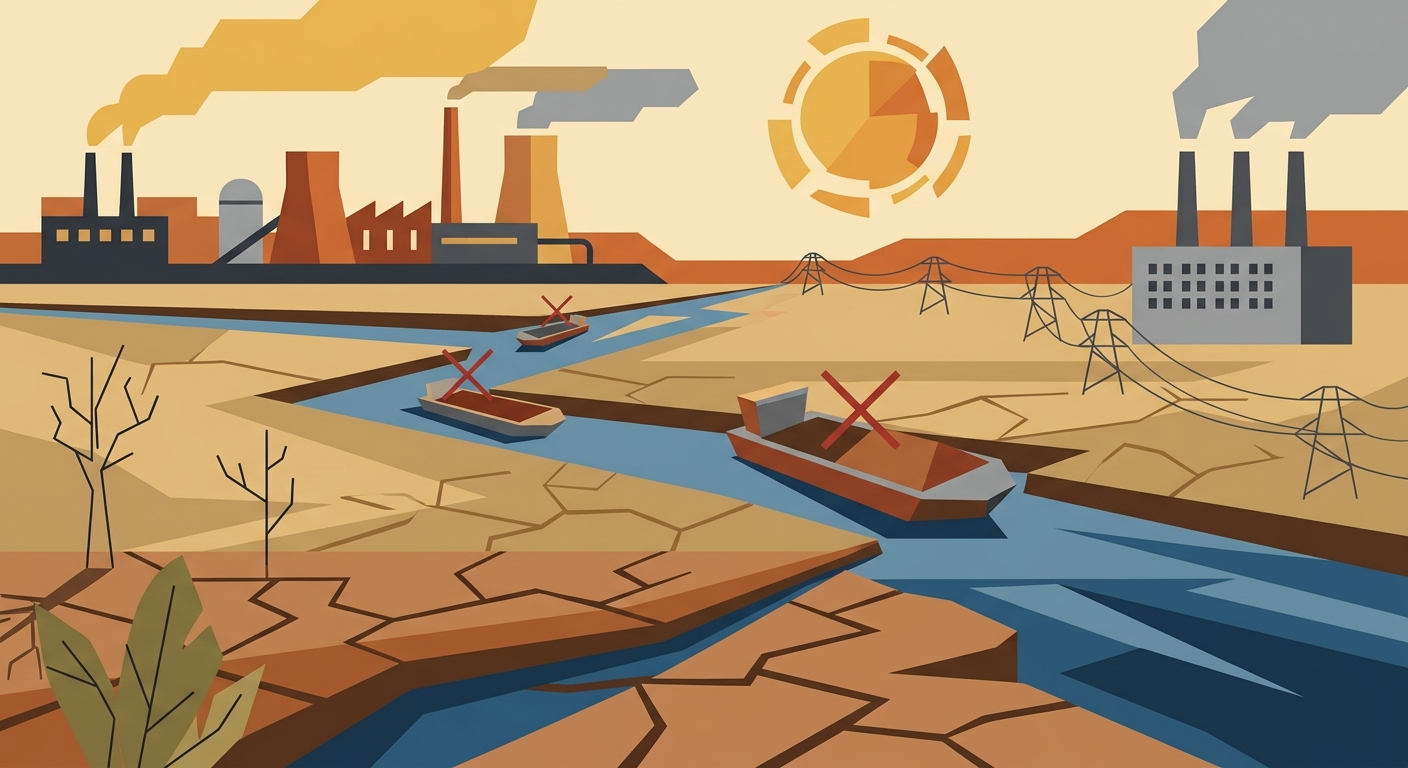
A severe heatwave gripping Europe is drying up the continent's most important inland waterways, with water levels on the Rhine and Danube rivers approaching or breaking records. The resulting disruption is rippling through the industrial heartlands of Germany, Hungary, Romania, Serbia, and beyond, forcing chemical giants, steelmakers, and even nuclear power plants to cut output or halt operations.
On the Rhine, which flows roughly 1,230 km from the Swiss Alps to the North Sea, the gauging station at Kaub, Germany — a critical chokepoint — recorded a water level of just 27 cm in late July 2024, below 30 cm and forecast to drop further. By July 27, most inland vessels were unable to pass Kaub, effectively cutting off the Upper Rhine and Main rivers from the Amsterdam-Rotterdam-Antwerp (ARA) trading hub, according to commodity pricing agency Argus.
The low water has directly hit industry. LyondellBasell declared force majeure on butadiene supplies from its Wesseling plant, citing disrupted feedstock deliveries due to low water, as reported by ICIS. BASF flagged possible force majeures or product shortages due to its reliance on Rhine transport. Thyssenkrupp reduced blast furnace production at its Duisburg plant, as barges carrying raw materials struggled at shallow points like Kaub.
Danube at record lows, nuclear plants affected
On the Danube, the situation is equally severe. In Budapest, Hungary, the river gauge fell to a record-low 23 cm on Thursday — 10 cm below the previous record set in 2018, according to Hungary's official water-monitoring service. Most cargo vessels halted along the Hungarian section; those still running carried only 10% to 20% of normal loads. Around 15 hotel ships were stranded on the Danube, and in Serbia, barges and tankers operated at 30% to 40% of capacity.
The low water forced Hungary's Paks Nuclear Power Plant to reduce output and shut down one of its four reactors — the first such shutdown of a complete block at the plant — bringing total capacity to about 60%. Romania's state-owned Nuclearelectrica shut down Unit 1 at the Cernavodă nuclear plant on Tuesday due to "very low, unprecedented" Danube levels, and planned to disconnect Unit 2 early Thursday, leaving both reactors offline for the first time simultaneously. Hungary covered the lost nuclear generation with imports and domestic gas-fired power, according to Mavir data cited by MTI.
Serbia's Energy Minister Dubravka Đedović Handanović stated that the country received only 25% of its planned fuel imports in July because low Danube levels restricted barge deliveries. Meanwhile, Europe's average high temperature on the reported Thursday was forecast to be 25.3°C (77.5°F), 3.6°C above the 1961-1990 norm, according to the Reuters Climate Monitor.