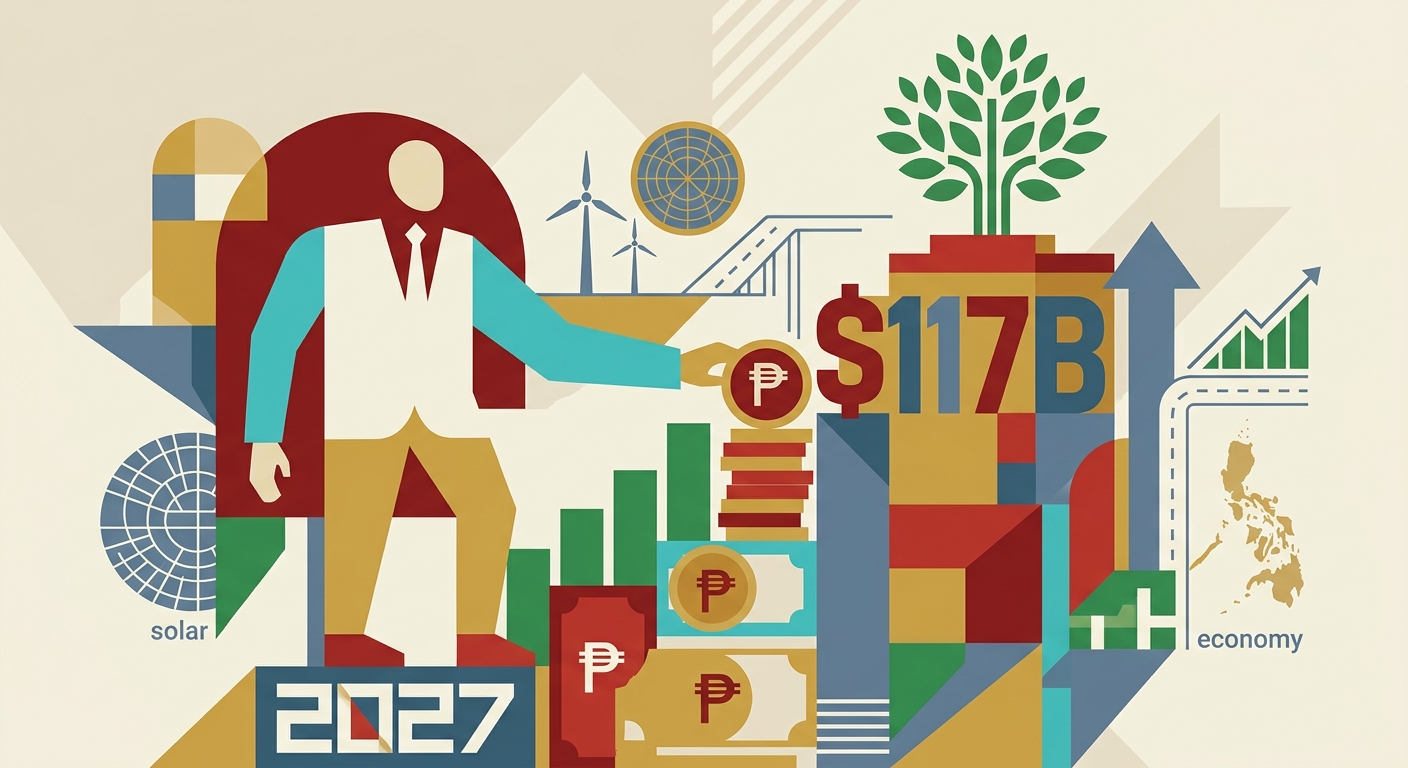
Philippine President Ferdinand Marcos Jr. has proposed a national budget of 7.2 trillion Philippine pesos for 2027, equivalent to approximately $117.5 billion (source: S1) or $118.1 billion (source: S3). The proposed spending plan is 6 per cent higher than the current year's budget.
Marcos described the package as a “prudent and forward-looking investment” aimed at sustaining economic growth and strengthening the country's resilience. The budget prioritizes strategic infrastructure, human capital, food and energy security, and social protection.
The proposed 2027 spending plan is equivalent to 21.7 per cent of the Philippines' gross domestic product, according to the Department of Budget and Management.
The final proposal is significantly lower than the 11.69 trillion pesos initially sought by government agencies, Marcos noted. The plan is anchored in the Philippine Development Plan 2023–2028 and the long-term Ambisyon Natin 2040 vision.
Economic context and growth challenges
The Philippine economy grew 2.3 per cent in the second quarter from a year earlier, its weakest pace since 2021. First-half growth was 2.6 per cent, below the annual target.
Sectoral allocations
Several sectors face cuts in the proposed budget. Education is allocated 1.15 trillion pesos, an 11.5 per cent decrease from the 1.3 trillion pesos this year. Healthcare receives 353.8 billion pesos, down 21 per cent from 448.1 billion. Agriculture gets 261.7 billion pesos, a 13 per cent cut from nearly 300 billion.
In contrast, the Department of Public Works and Highways would receive 644 billion pesos, a 22 per cent increase from the 530 billion allocated for 2026. This follows a year when its budget was cut by approximately 40 per cent from a proposed 881 billion pesos due to allegations of irregularities in public works projects. Defence spending is proposed at 328.8 billion pesos, up 7.6 per cent.
The Department of Budget and Management stated that 316 billion pesos, or nearly four-fifths of the budget increase, would cover mandatory obligations such as salary adjustments for military and uniformed personnel.
Budget Secretary Kim Robert De Leon told a press conference that the government expects total disbursements of 6.9 trillion pesos in 2027 against projected revenues of 5.2 trillion pesos, resulting in a fiscal deficit of 1.7 trillion pesos to be financed through borrowing.
The government has set a GDP growth target of 5.0 per cent to 6.0 per cent for the period of 2027 to 2030.